Tailored Education: How I Replaced Online Courses with Personalized AI-Powered Learning
A colleague recently asked me to recommend a good blockchain course. My answer surprised him: “Don’t buy one – build your own in 15 minutes.” And that’s exactly what he did.
Until recently, learning meant one of two things: either you follow a standard course, or you piece together knowledge on your own. With LLMs, a third path has emerged – learning can be designed for a specific person, their goals, pace, knowledge gaps, and interests. In essence, AI becomes not just a source of answers, but an architect of a personal curriculum, an examiner, and a training simulator.
Map → Zoom → Build → Simulate
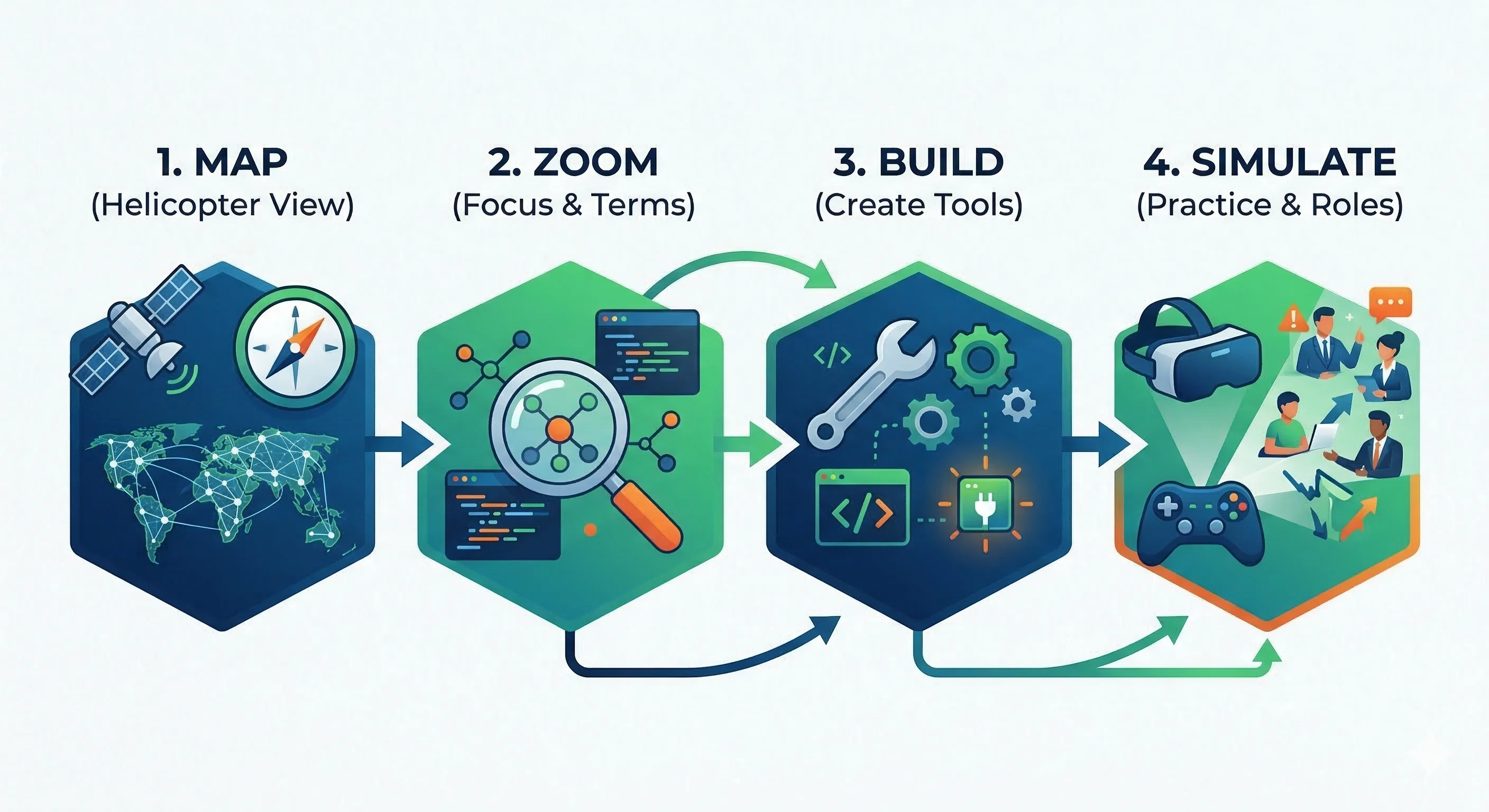
Here’s the approach I’ve developed for myself:
- Map. I ask the AI to explain the entire topic in plain language, without overloading on terminology – a 30-minute helicopter view. I don’t need depth yet, just a map of the landscape: what is the big picture, and what are the building blocks of this field.
- Zoom. I put together a short 1–2 hour course, now with hands-on exercises. Terms appear here, but only the ones I need right now. Then come review questions and deeper dives only into areas where I actually have gaps.
- Build. Next, I move from explanations to tools built along the way. Learning a new framework – it’s easier to just build something right away. Reading a strategy book – I quickly assemble an AI-powered script that analyzes any company through the proposed model. When you’re not just reading but building, understanding goes much deeper.
- Simulate. Here, AI works as a training simulator. For example, while studying an entrepreneurship course, I ran simulations where the AI threw unexpected market crises at me and forced me to make quick decisions.
The result isn’t a linear course – it’s a map you can navigate at different depths. Where I already know the material, I move fast. Where there are gaps, I stop and dig in.
Case Study: Minecraft vs. Textbooks
My most vivid example didn’t come from work – it happened at home. I started teaching my son Python programming. Instead of abstract exercises, we connected Python to something he’s genuinely excited about right now – building in Minecraft.
Books and ready-made materials were easy to find, but we quickly got stuck: libraries had been updated, code didn’t work, and his interest started fading.
So I switched to LLMs. With their help, I quickly got everything set up for current conditions – no wandering through forums, no trying to revive year-old examples. Learning instantly turned into a quest: terraforming his own world, building castles, automation. Explanations were built on analogies from his hobbies – chess and sports – tailored to his age and school level. If a chapter didn’t land, I rewrote it with AI until the delivery clicked for him specifically.
Not a course for all kids – a course for this particular child. That’s tailored education – learning that adapts to you in real time.
But this isn’t just – or even primarily – a story about teaching children. Using the same approach, I’ve built courses for myself to enter the topics of interest: marketing, Agentic AI, unfamiliar domains – where I need to quickly build a map, move to practice, and not drown in the unnecessary.
How to Avoid Drowning in Hallucinations
Of course, AI in education isn’t the ultimate source of truth – it’s a powerful navigator that requires verification. For conceptual topics, I ask for source references, theoretical frameworks, and documentation, and I double-check anything debatable. For technical topics, verification is simpler: if you’ve built something, it either works or quickly shows you exactly where you didn’t understand the material.
But even with that caveat, the value is very high. The time-to-value of this approach is noticeably better than many static courses and books.
Conclusion
LLMs are changing education not because they “know everything better than anyone,” but because they make learning adaptive, up-to-date, and assembled for a specific person. Previously, this level of customization was only possible with an exceptional instructor or in an expensive one-on-one format. Now it’s becoming far more accessible.
I believe that in the coming years we’ll see a shift from standardized courses to learning that’s assembled dynamically – tailored to the goal, context, level, and interests of each individual. And this isn’t a prediction – it’s how I learn today.